
CT-Unite Robot Motion Control Development RMCS V1.0 Release
Release time:2026-08-29 14:56:56
Zhongke Wireless Semiconductor focuses on the research, development, production, and sales of IDPU specialized chips for robot "cerebellar" motion control and GaN drive control integrated joint chips. The team has been integrating physics based AI underlying algorithms into the CT-2001A IDPU cerebellar chip core through hardware technology for a long time. Through the Intelligent‑Distributed Processing Unit (IDPU) brain like intelligent chip core on the end side, a distributed attitude balance action neural network is built to calibrate simulation data with real machine physical data (DH parameter/inertia/friction matching) and achieve PTP hardware level clock synchronization, dynamic interpolation compensation algorithm and other data time alignment, accelerating the commercialization process and lightweight deployment of industry wide robot brain models. It is a bridge connecting the digital brain of robots with the physical world.
The company has officially released a standardized integrated software and hardware tuning platform for robot bodies CT-Unite Robot Motion Control System V1.0。 The platform is based on the CT-2001A cerebellar IDPU brain intelligence chip as the core, integrating the CT-2001B+CT-1902 high-performance drive control integrated joint chip, dexterous hand dedicated chip, and 4D spectral sensor to build a dedicated debugging system for the development of brain like robot components.
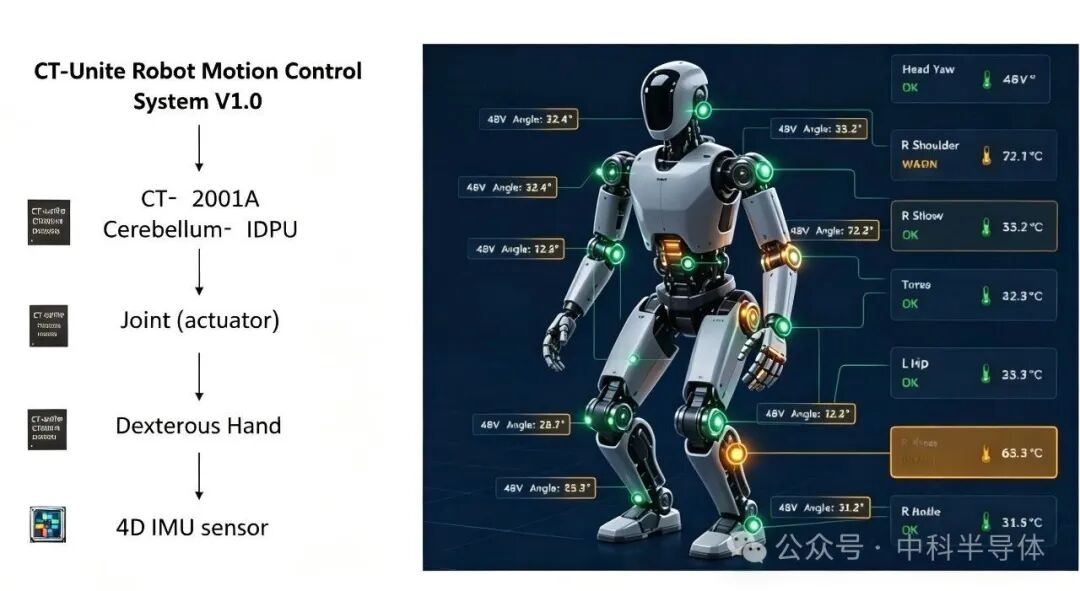
Taking the actuator (joint) tuning module as an example: This tuning module is deeply adapted to the hardware acceleration unit built into CT-2001B, integrating advanced motor control core algorithms such as motor physical model, automatic parameter identification, FOC vector control, PID, etc. It supports manual/fully automatic loop tuning and has AI fault diagnosis and automatic repair capabilities. It can help robot manufacturers significantly reduce the R&D and debugging cycle, achieving joint development from prototype to mass production in just 45 days. At present, the solution has been mass-produced and implemented in multiple top customers in China, helping enterprises efficiently, high-performance, and standardized achieve independent research and development of robot joints and large-scale production and delivery.
CT Unit RMCS V1.0 Debugging Interface
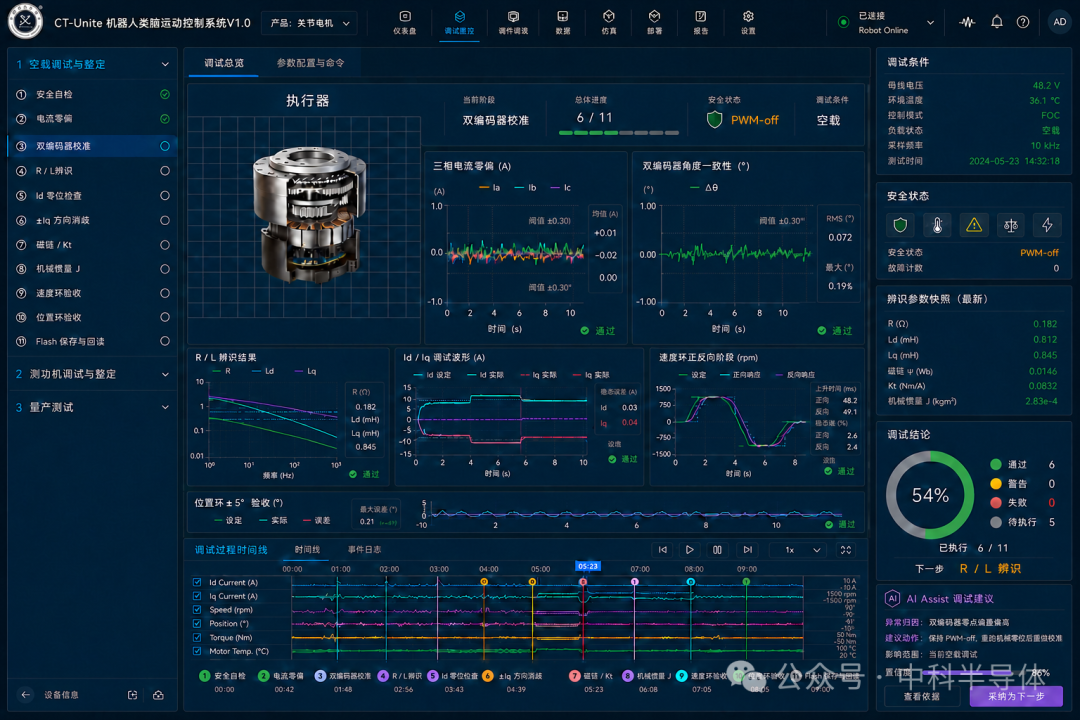
Built in full stack servo algorithm for one-stop motor performance tuning: The CT Unit RMCS V1.0 platform is deeply adapted to the complete set of servo control algorithms for the CT-2001X series chips, covering all scenarios of various drive motors, reducers, and peripheral sensors. It completes one-stop performance calibration and optimization, helping whole machine enterprises reduce external procurement costs and improve the rapid adaptation ability of robot brain models. This chip solution natively integrates a complete closed-loop motion control model matrix, with core models covering FOC vector control, ADRC self disturbance rejection control, S/T intelligent trajectory planning, electrical/dynamic automatic parameter identification, cogging torque compensation, inverter dead zone compensation, encoder linear error calibration, load disturbance observation, compliant force control, active vibration reduction and stabilization, and a complete set of advanced motion control algorithms.
The platform is equipped with standardized and unified calling interfaces, so enterprises do not need to independently develop, rewrite or reconstruct underlying control code. They can quickly call core modules such as built-in neural networks, basic matrices, calculus, PID algorithms, etc. through visual debugging interfaces or API interface parameter tuning, efficiently completing secondary development and equipment debugging, and accurately landing robot actuator research and development work.
This solution completely eliminates the heavy underlying mathematical modeling and dynamic algorithm development work in traditional projects, significantly reducing the dependence of complete machine enterprises on high-end servo algorithm R&D talents, and promoting the fundamental transformation of robot joint (actuator) R&D mode: upgrading from the traditional "underlying algorithm R&D led" to the "standardized software calling+visual simple parameter tuning" dual drive mode, significantly reducing the threshold for engineering debugging and accelerating new product iteration.
Core values of the plan
Cycle acceleration: Equipped with a dedicated tuning platform for integrated drive control chips, the joint can be developed and mass-produced in as little as 45 days;
Cost reduction: Shorten the supply chain hierarchy and lower the overall material cost of the entire machine from the hardware source;
Zero layer development: A complete set of servo algorithms with built-in standardized interfaces, without the need for self-developed low-level control code;
Talent reduction: Get rid of the dependence on high-end servo algorithm talents, ordinary engineers can complete the whole machine debugging;
Full scene adaptation: covering the full range of motion control requirements such as motor control, sensor calibration, force control, vibration reduction, trajectory planning, etc;
Large scale model implementation: Assisting in lightweight end-to-end deployment of brain models, connecting virtual and real data linkage;
Worry free after-sales service: solves the problem of indicator deviation after the joint installation and running in period, supports automatic tuning and repair.